
Tracking gas structures.
In an oil–dense gas loop, a sensor at one location can time a gas pocket passing. A distributed network lets researchers look for that pocket again farther downstream.
Inside the measurement campaign
The NUEM team circulated mineral oil and sulfur hexafluoride through a horizontal pipe with a 25.75 mm bore at 5 bar absolute and 35 °C. Each four-minute run captured all ten channels simultaneously. Ethernet-connected nodes recorded the two signals at each station on a common time basis.
Following the same passage downstream
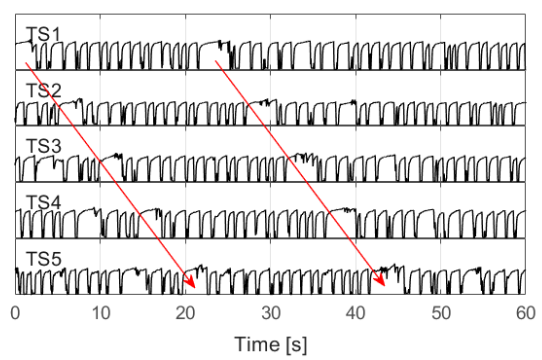
The arrows connect selected elongated structures across the five station records. Their arrival times shift downstream. The traces also show why matching every peak from one station to the next would be unreliable.
Distributed phase fraction sensors for oil-dense gas flow investigation
Natan Reginaldo, Ana Santana, Gabriel Willig, Alberto Postal, Moisés A. M. Neto, Marco da Silva, Rigoberto Morales and Eduardo N. dos Santos.
Research by NUEM / UTFPR with collaborators from Johannes Kepler University Linz and CENPES / Petrobras. Paper 142, SPE Brazil Flow Assurance Technology Congress, Rio de Janeiro, November 2026.
View conference programme ↗